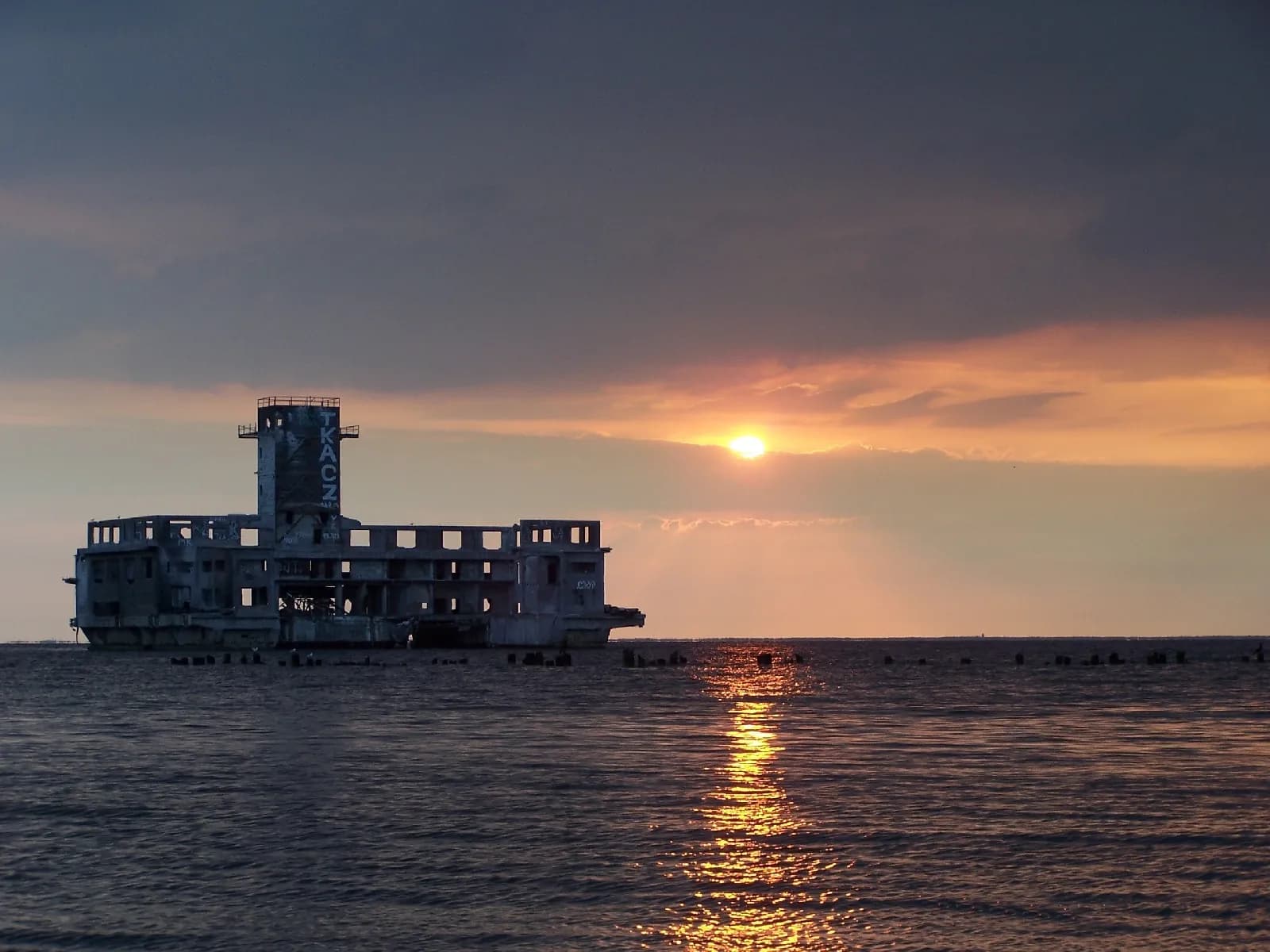
The concrete ruin off Babie Doły
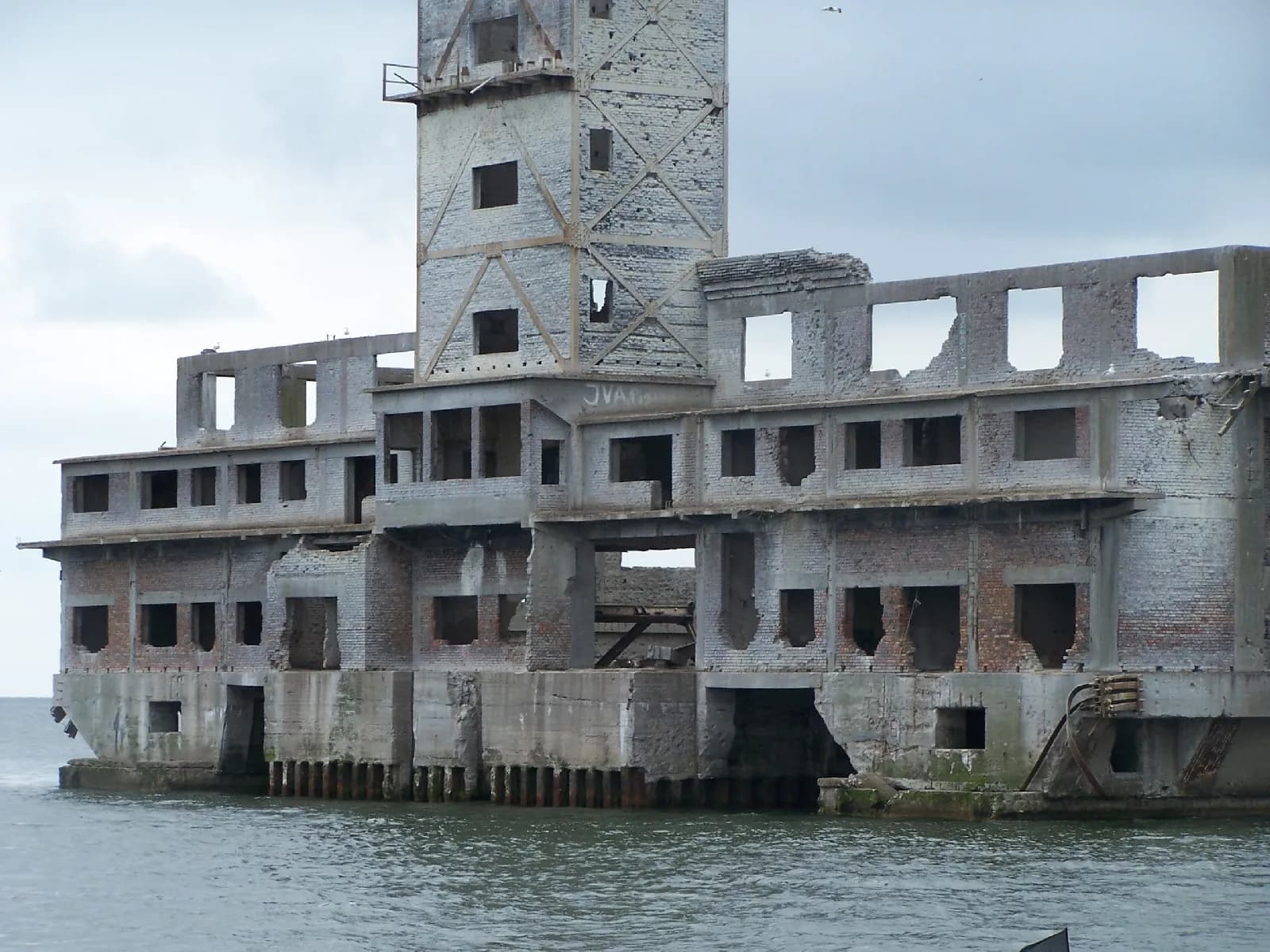
Standing in the Baltic just off the beach at Babie Doły, the remains of the Torpedownia have become one of Gdynia's most recognisable coastal landmarks.
The concrete structure is weathered, broken and increasingly difficult to distinguish from the sea around it. From the shore, however, its outline is unmistakable.
It is also easy to forget just how much was once here.
The structure was part of a large German military research and testing complex established during the Second World War, when Gdynia had been renamed Gotenhafen and turned into an important naval and military centre.
The offshore ruin is the surviving fragment of a much larger story.
A wartime testing ground at Babie Doły
German authorities developed two major torpedo facilities around Gdynia during the occupation. The installation at Oksywie was primarily connected with the Kriegsmarine, while the facility at Babie Doły became associated with the Luftwaffe and the testing of aerial torpedoes.
The Babie Doły complex was known in German as Torpedowaffenplatz Hexengrund. Construction began in 1940 and the facility was officially opened in July 1942.
The choice of location was practical. The waters of the Gulf of Gdańsk and the Puck Bay area offered extensive space for testing, while the military installations on land could support the work taking place offshore.
The site developed into a substantial technical complex, with workshops, storage facilities, electrical installations, observation posts and other military buildings. There was also an airfield and a narrow-gauge railway linking parts of the wider coastal military infrastructure.
The familiar ruin was therefore only one part of the facility.
The Babie Doły installation was principally concerned with aerial torpedoes. Its position in the sea was not accidental. It formed part of an engineered testing environment, connected to the shore by a pier and supplied by the infrastructure on land.
The result was a remarkable piece of wartime engineering hidden in plain sight on the edge of Gdynia.
The complex that disappeared
Today, it is the offshore building that attracts photographers, walkers and anyone curious about Gdynia's unusual coastline.
Much of the original complex, however, has disappeared from everyday view.
Historical research by the Muzeum Miasta Gdyni records workshops, technical buildings, storage facilities, shelters, railway infrastructure and other remains connected with the Torpedowaffenplatz. Some wartime structures and bunkers still survive around Babie Doły, although they are far less conspicuous than the concrete building in the sea.
The coastline can therefore be read almost like an archaeological landscape. The paths, cliffs and wooded areas around Babie Doły contain traces of an extensive military site that once operated here.
The railway that linked the coast
Another forgotten part of the story is the railway.
A narrow-gauge coastal railway connected the military installations around Oksywie and Babie Doły. It was used to move equipment and materials around the complex and formed part of the logistical network supporting the torpedo facilities.
Documents preserved by the Muzeum Miasta Gdyni include evidence of the railway connection and its use during the wartime period.
It is a reminder that the Torpedownia did not operate in isolation. The concrete structure in the water depended on a whole network of workshops, transport links, technical buildings and military personnel on shore.
After the war
The German military presence in the area ended in 1945 as the fighting reached the Gdynia and Kępa Oksywska area.
The Torpedowaffenplatz was abandoned and much of its equipment was subsequently removed or dismantled. Unlike some military installations around Gdynia, the Babie Doły offshore building did not develop into a continuing operational facility.
Its long decline was shaped by something that cannot easily be stopped: the Baltic Sea.
Waves, salt water, wind, freezing temperatures and corrosion have steadily damaged the concrete and metalwork. The original connection with the shore has disappeared, while sections of the building have collapsed over the decades.
What remains is consequently far removed from the carefully engineered facility completed during the war.
From military installation to Gdynia landmark
The Torpedownia eventually acquired a very different place in the city's imagination.
The ruin became a familiar sight from Babie Doły beach and a popular subject for photographers. Its stark silhouette against the Baltic has also made it a natural location for Polish film and television productions, including Czterej pancerni i pies.
For generations growing up around Gdynia, the building has been part of the landscape rather than simply a historical site.
That makes its story particularly unusual. A structure created for weapons research during the occupation has become one of the visual markers of the city's northern coastline.
What happens to Torpedownia next?
The condition of the building raises an increasingly difficult heritage question.
Restoring an ordinary historic building is one thing. Restoring a deteriorating concrete structure standing offshore in the Baltic is quite another.
Access, structural safety, marine exposure and the cost of conservation all present serious challenges. There is also a question of what restoration should actually mean. Should the ruin be returned to something resembling its wartime appearance, stabilised in its present state, or allowed to continue ageing as part of the coastline?
For now, the building remains offshore, slowly being reshaped by the same sea that once made Babie Doły an ideal place for torpedo testing.
See more: The Gdynia U-Boat Legend: Separating Wartime Fact from Maritime Folklore
Source: Muzeum Miasta Gdyni
Image credit: Leszek Pietrukaniec, Wikimedia Commons, CC BY-SA 3.0