For generations of Poles, leaving home meant crossing a threshold into uncertainty. In Gdynia, that journey has found a place to be remembered.
Emigration is often described through numbers: people leaving, countries reached and generations born far from their family's homeland. But behind every figure is a journey, and behind every journey is a decision to leave one place and begin somewhere else.
In Gdynia, the Emigration Museum explores that experience from a setting with an unusually direct connection to it. The museum occupies the historic Maritime Station in the heart of the city's port, a building through which generations of passengers once passed on their way out into the world.
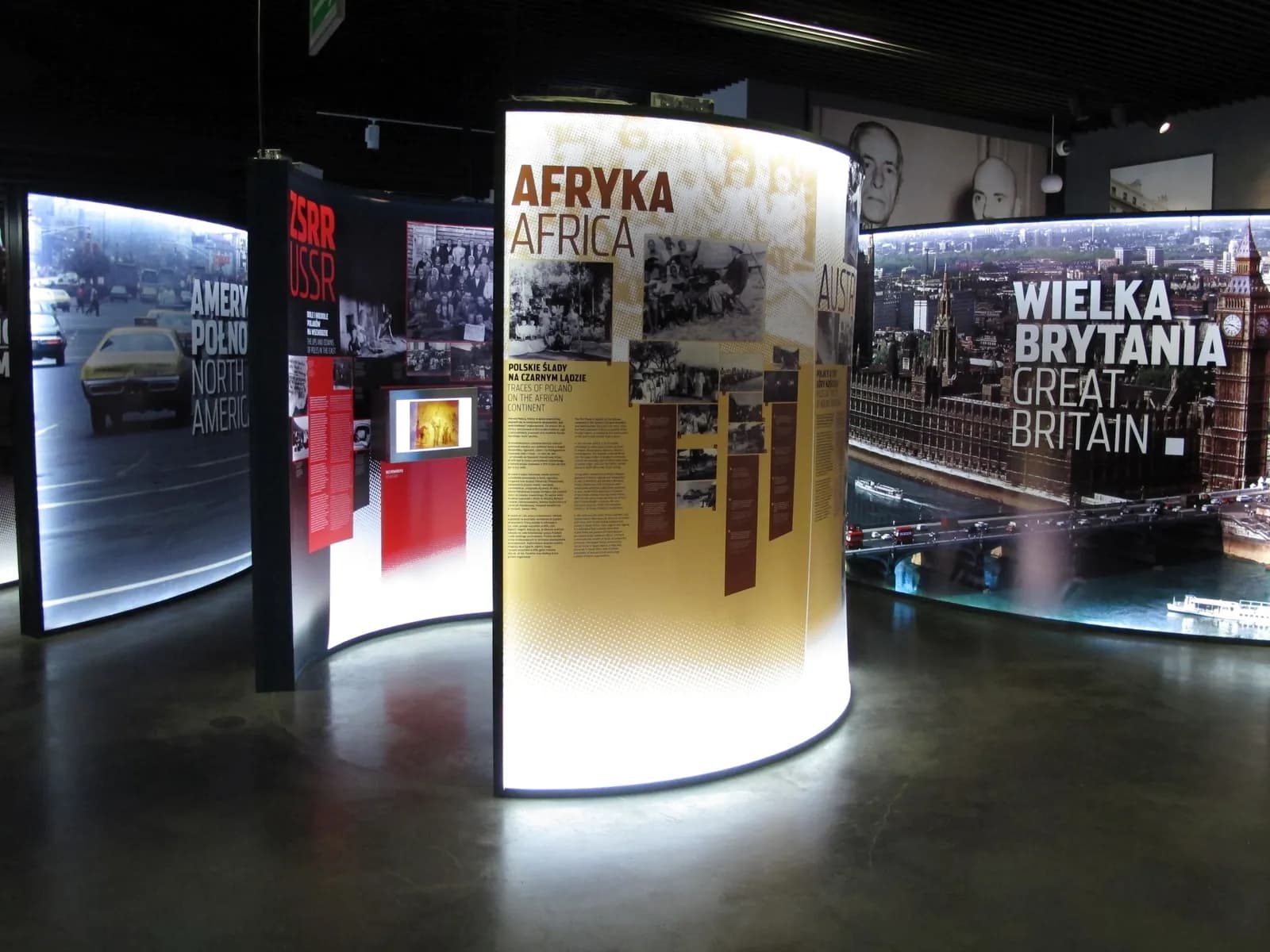
Opened to the public in 2015, the Emigration Museum was established as Poland's first institution dedicated to the history of Polish emigration. Its permanent exhibition follows the experiences of Polish women and men who left their homes for work, freedom and the possibility of a different life, placing those journeys within a much longer history of movement from Polish lands.
The subject remains relevant because emigration did not end with the twentieth century. Following Poland's accession to the European Union, migration became a familiar part of life for another generation, turning the experience of living abroad into something known to millions of Polish families.
A museum shaped by the place where journeys began
The decision to establish the museum in Gdynia's Maritime Station gives the story a physical starting point.
Opened in 1933, the station was the centre of pre-war passenger traffic at the port. Polish ocean liners including MS Batory departed from Gdynia, while the wider infrastructure supporting emigration extended to facilities such as the Emigration Camp in Grabówek and the quarantine hospital in Babie Doły.
The station was designed for more than practical efficiency. It was also a symbolic gateway. For emigrants leaving Poland, it could be the last image of their homeland. For passengers arriving from abroad, it could be their first.
That dual role reflected the character of Gdynia itself. The young port city represented the ambitions of the newly independent Polish state, while its position on the Baltic made it naturally outward-looking. The Maritime Station's architecture combined monumental elements with modernist functionality, expressing both national confidence and an openness to the wider world.
By the outbreak of the Second World War, hundreds of thousands of people had already departed from the station. Passenger shipping would later return on a smaller scale, but the era of Polish ocean liners eventually came to an end, with the last Polish ocean liner decommissioned in 1988.
The building therefore provides more than a dramatic backdrop for the museum. Its walls are part of the story.
The past of emigration is also part of Poland's present
The permanent exhibition widens the perspective beyond Gdynia. Polish emigration stretches across centuries and continents, driven by different circumstances and experienced in profoundly different ways.
Some left in search of employment or economic security. Others sought freedom or were forced to leave by political circumstances. The routes changed with technology and circumstance, from journeys on foot and by train to ocean crossings and, later, air travel.
Today, the global Polish diaspora numbers more than 20 million people of Polish descent, according to the museum. That figure points to the scale of a phenomenon that has influenced families, communities and Polish identity far beyond the country's borders.
The museum's purpose is not simply to catalogue these movements. It asks what happens to identity when people leave, how Polishness is maintained across generations and what it means to belong to a country while living somewhere else.
That makes the museum's subject relevant to contemporary Poland. For many families, emigration is not a distant historical theme but part of recent experience. A relative may have moved abroad for work, a friend may have built a life elsewhere, or a younger generation may have grown up between countries.
The museum consequently treats migration as an ongoing process rather than a closed chapter. Its stories encompass emigrants and immigrants, connecting individual experiences of departure and arrival with wider questions about belonging.
A historic building given a new life
The Maritime Station itself has undergone a remarkable journey. Severely damaged during the Second World War, it remained in need of comprehensive reconstruction for decades. A major restoration eventually brought the building back into use, with work including reconstruction of parts of the Passenger Concourse, restoration of façades and the reinstatement of architectural details including eagle bas-reliefs and decorative plasterwork.
The restored building combines its historic character with contemporary functions. A glass wall opens towards the sea, while a spacious terrace makes use of the museum's position within the port. The building has also been adapted to provide accessibility for people with disabilities.
Its renewed role has created an interesting reversal. Once, the Maritime Station was a place where people prepared to leave Poland. Today, it is a place where those journeys can be examined, remembered and discussed.
That connection between place and subject is what gives the Emigration Museum its particular character. Gdynia's port remains a gateway to the world, but the museum asks visitors to pause before crossing it and consider what departure means. In a country whose history has been shaped by people leaving and returning, the journey is not simply about distance. It is also about memory, identity and the continuing ways in which Poland remains connected to its people around the world.
Visitor Information
Emigration Museum in Gdynia
Polska 1, Gdynia
Opening hours:
Monday: Closed
Tuesday: 12:00–20:00
Wednesday: 10:00–18:00
Thursday: 10:00–18:00
Friday: 10:00–18:00
Saturday: 10:00–18:00
Sunday: 10:00–18:00
Admission to the permanent exhibition:
Standard ticket: PLN 28
Reduced ticket: PLN 20